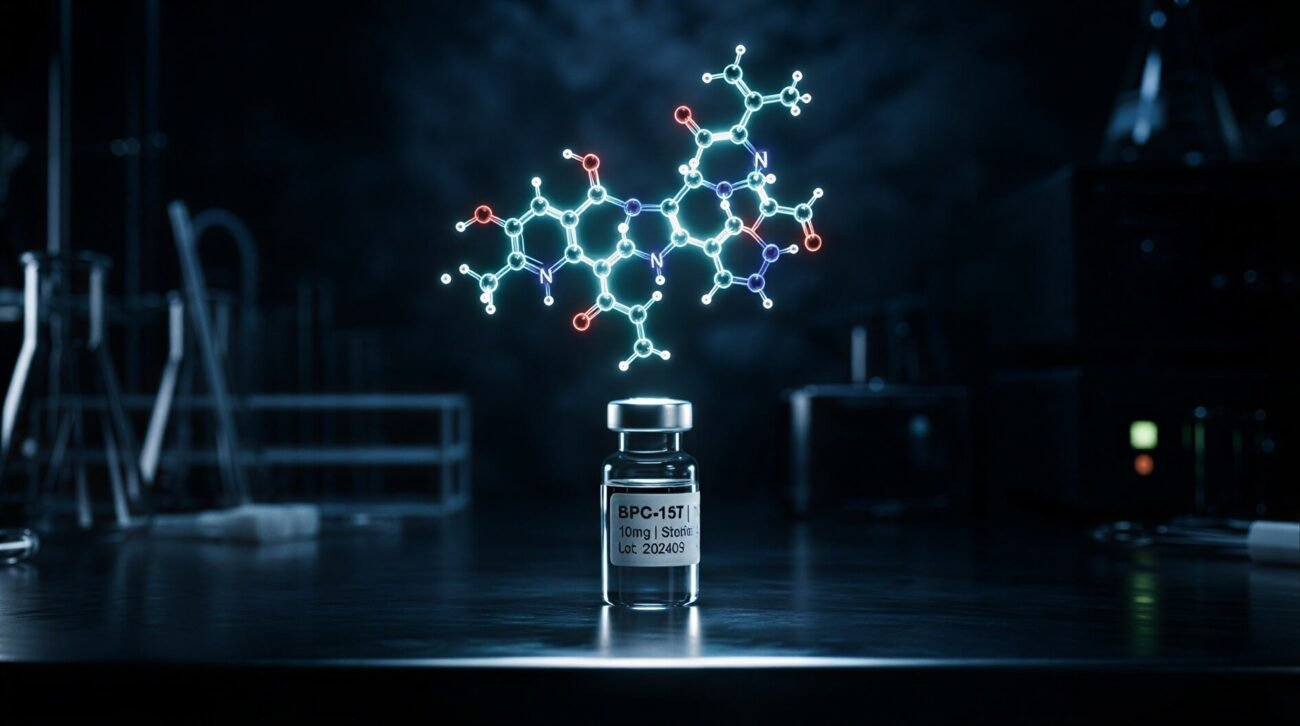

BPC-157 is a synthetic pentadecapeptide that has attracted significant interest among researchers exploring peptide-based compounds. Sometimes referred to as Body Protection Compound 157, this peptide has been the subject of numerous laboratory studies. This guide explains what BPC-157 is, how it is being studied in research settings, its properties, and how it compares to related research peptides such as TB-500. All information in this guide is provided for laboratory research purposes only and is not intended for human consumption.
What is BPC-157?
BPC-157 is a synthetic peptide consisting of 15 amino acids derived from a partial sequence of a naturally occurring gastric protein found in the human digestive system. First synthesised in the 1990s, BPC-157 has since become one of the most studied research peptides in preclinical laboratory settings.
The compound’s full name, Body Protection Compound 157, reflects the section of the parent protein from which its sequence was originally isolated. In its synthetic form, BPC-157 is typically supplied as a lyophilised (freeze-dried) powder that must be reconstituted with bacteriostatic water before it can be used in research.
At Peptiq Peptides, BPC-157 10mg is supplied in vials for UK research use only. Every batch is independently third-party tested and shipped with a Certificate of Analysis so that researchers can verify identity and purity before beginning any study.
Because BPC-157 is intended solely for laboratory research, this guide does not provide dosage instructions for human use. Instead, the sections below discuss the compound’s structure, the research contexts in which it has been examined, and considerations relevant to safe laboratory handling.
Origins and Structure of BPC-157
BPC-157 is a 15-amino-acid peptide with the sequence Gly-Glu-Pro-Pro-Pro-Gly-Lys-Pro-Ala-Asp-Asp-Ala-Gly-Leu-Val. This sequence was originally identified as part of a larger protein isolated from human gastric juice, and the synthetic version replicates that fragment exactly.
Unlike many peptides that require careful stabilisation, BPC-157 has demonstrated notable stability in aqueous solutions under laboratory conditions, a property that has made it particularly attractive to researchers studying peptide behaviour in various biological environments.
The molecular weight of BPC-157 is approximately 1419 Daltons, and it is soluble in water and standard aqueous solvents. Its structure allows it to be reconstituted with bacteriostatic water without the need for specialised solvents, which is one reason why bacteriostatic water is the standard reconstitution medium among researchers working with this compound.
BPC-157 Research Benefits and Applications
Research into BPC-157 has explored a range of biological activities in animal and cellular models. Studies have investigated the peptide’s potential effects on tissue repair, gastrointestinal integrity, and various tendon and ligament models. It is important to emphasise that this research has been conducted in laboratory settings on animal models and cell cultures, and no conclusions can be drawn about effects in humans without properly conducted clinical trials.
Areas of research interest have included:
- Gastrointestinal research models, particularly studies exploring peptide effects on mucosal integrity
- Musculoskeletal research examining tendon and ligament cell behaviour in culture
- Angiogenesis research investigating peptide effects on new blood vessel formation in vitro
- Neurological research using standard laboratory models
None of these research findings constitute evidence of clinical benefit in humans. BPC-157 is not a licensed medicine in the United Kingdom or any other jurisdiction, and researchers should treat all published findings as preliminary and hypothesis-generating rather than definitive.
BPC-157 Dosage in Research Settings
Because BPC-157 is supplied for laboratory research only, dosing must be planned in accordance with the specific research protocol being followed and the study design that has been approved by the relevant institutional review body.
Reconstitution
BPC-157 is supplied as a lyophilised powder in a sealed vial. Before use, it must be reconstituted using bacteriostatic water. The recommended reconstitution procedure is:
- Allow both the peptide vial and the bacteriostatic water to reach room temperature
- Add the required volume of bacteriostatic water slowly down the inside wall of the vial
- Gently swirl the vial to dissolve the peptide, taking care not to shake it
- Once fully dissolved, the solution should be clear
For a step-by-step guide to peptide reconstitution and handling, please refer to the Peptiq Peptide Guide.
Concentration Calculation
The concentration of the reconstituted solution depends on the volume of bacteriostatic water used. For example, adding 2ml of bacteriostatic water to a 10mg vial of BPC-157 produces a final concentration of 5mg per ml, or 5,000 micrograms per ml.
Researchers should calculate the concentration required for their specific study design and adjust the reconstitution volume accordingly.
Storage Considerations
Unreconstituted BPC-157 should be stored refrigerated at 2 to 8 degrees Celsius, away from light. Once reconstituted, the solution should be kept refrigerated and used within the timeframe recommended by the researcher’s protocol, typically within four weeks.
BPC-157 vs TB-500: What Is the Difference?
Both BPC-157 and TB-500 are research peptides that appear frequently in the same discussions, but they are structurally and mechanistically distinct compounds. Understanding the differences is important for researchers designing comparative studies.
Structural Differences
BPC-157 is a 15-amino-acid peptide derived from a fragment of gastric protein sequence. TB-500 (Thymosin Beta-4 fragment) is a synthetic peptide based on a portion of the naturally occurring protein Thymosin Beta-4, which is found in blood platelets and other tissues. TB-500 is significantly different in both origin and structure.
Mechanism Differences
The two peptides have been studied for different mechanisms of action in research models. BPC-157 research has often focused on tissue integrity and localised repair models, while TB-500 research has explored actin-binding activity and cell migration in laboratory settings.
Research Applications Compared
Some researchers explore both compounds in tandem in preclinical models, and Peptiq Peptides offers a Wolverine research stack that combines BPC-157 and TB-500 in a single formulation for laboratory studies that require both peptides.
How to Store BPC-157
Proper storage is essential to preserve the integrity of any research peptide.
Before reconstitution:
- Keep the vial refrigerated at 2 to 8 degrees Celsius
- Protect from direct light by keeping the vial in its original packaging
- Do not freeze unreconstituted BPC-157 unnecessarily, as repeated freeze-thaw cycles can affect peptide stability
After reconstitution:
- Store the reconstituted solution refrigerated at 2 to 8 degrees Celsius
- Use within the timeframe specified by the research protocol
- Avoid exposure to light
- Do not use if the solution appears cloudy or discoloured
Detailed storage guidance for all research peptides is available in the Peptide Guide.
Purity and Certificates of Analysis
Purity is critical in any peptide research programme. Impurities can confound results and introduce variables that make interpretation difficult.
At Peptiq Peptides, every batch of BPC-157 is independently third-party tested. Testing typically covers:
- Identity confirmation through mass spectrometry
- Purity analysis by high-performance liquid chromatography (HPLC)
- Verification against the expected 15-amino-acid sequence
A Certificate of Analysis (COA) is available on request for every product. Researchers who need documentation for their study records or institutional review requirements can contact Peptiq for COA copies.
For more information about how COAs are prepared and what data they contain, please see the About Us page.
Frequently Asked Questions About BPC-157
Is BPC-157 legal to buy in the UK?
BPC-157 can be purchased in the UK for laboratory research use only. It is not a licensed medicine and must not be used for human or veterinary consumption. Buyers are responsible for ensuring their use complies with applicable UK research and workplace regulations.
What is the shelf life of BPC-157?
Unreconstituted BPC-157 stored correctly typically has a shelf life of 24 months. Once reconstituted, the solution should be used within the timeframe specified by the research protocol.
Can BPC-157 be reconstituted without bacteriostatic water?
Bacteriostatic water is the standard reconstitution medium for BPC-157 because it contains benzyl alcohol as a preservative, which limits microbial contamination during storage of the reconstituted solution. Other sterile solvents can be used depending on the research protocol, but bacteriostatic water is the most common choice.
Does Peptiq include BAC water with BPC-157?
Yes. Every BPC-157 10mg vial from Peptiq ships with a free 3ml bacteriostatic water vial for reconstitution.
What is the difference between BPC-157 and TB-500?
BPC-157 and TB-500 are distinct research peptides with different origins, structures, and mechanisms of action. BPC-157 is a 15-amino-acid peptide derived from a gastric protein sequence, while TB-500 is a synthetic fragment of Thymosin Beta-4. They are sometimes studied together in comparative research.
Where to Buy BPC-157 UK
BPC-157 is available for UK research use from Peptiq Peptides. Every batch is independently third-party tested, ships with a Certificate of Analysis on request, and is dispatched discreetly from the UK. To order BPC-157 10mg for laboratory research, visit the Peptiq product page. Every order includes a free 3ml bacteriostatic water vial for reconstitution.
Researchers looking to explore the wider Peptiq range can also shop all research peptides from the main store.
Important Disclaimer
The information in this guide is provided for educational purposes only and is intended for laboratory research use. BPC-157 is not a licensed medicine in the United Kingdom or any other jurisdiction, and no product sold by Peptiq Peptides is intended for human consumption or medical use. Researchers are responsible for ensuring their use complies with all applicable UK research and workplace regulations.